 Deutsch
 Français
 Italiano
 Nederlands
 Spanish

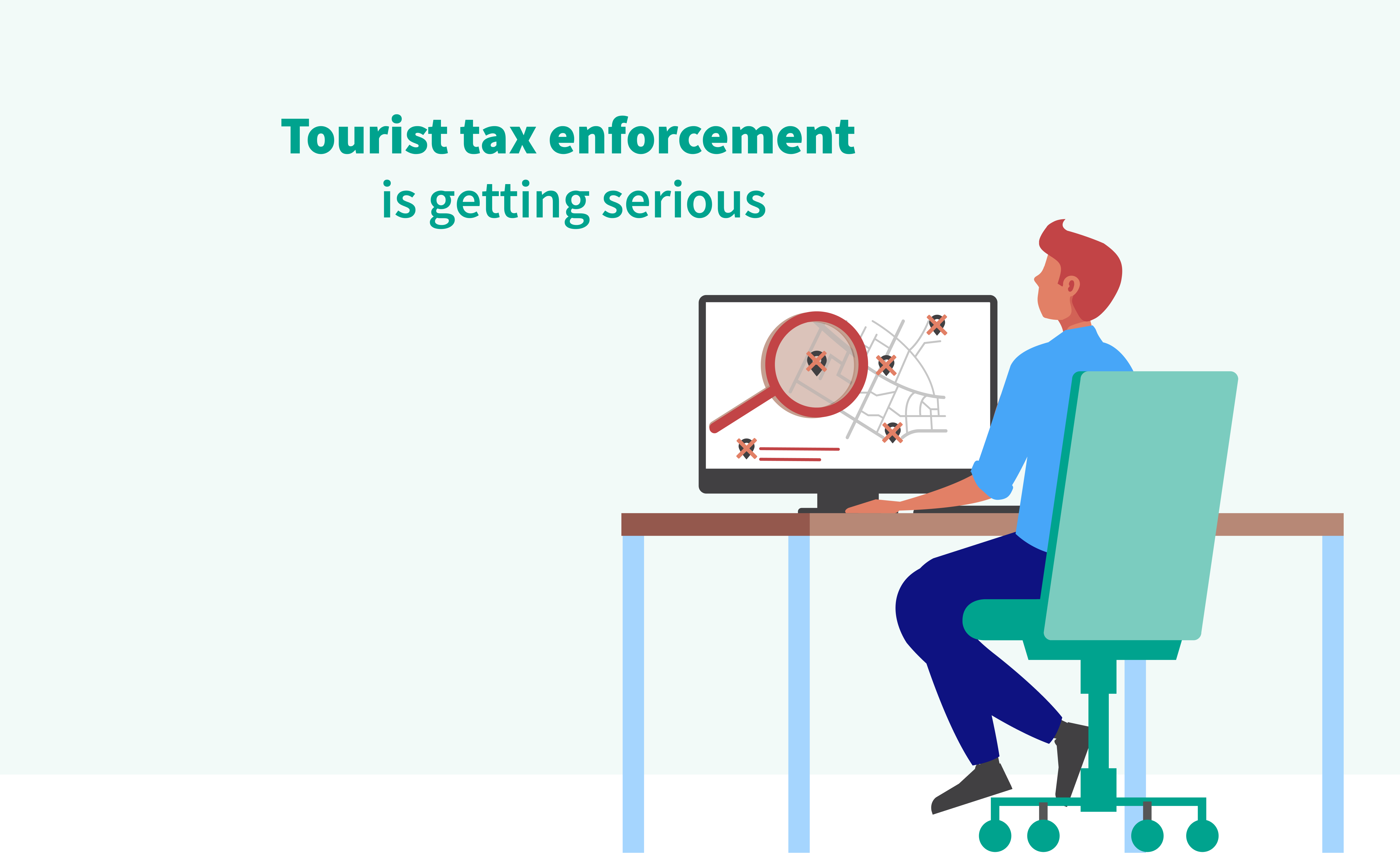
Tourist tax enforcement is getting serious: authorities step up compliance efforts
For years, many platforms and hosts did not treat tourist tax compliance as a priority. Governments had tax rules in place but often lacked the tools or will to enforce them. That is changing. In 2025, enforcement is stronger. Countries are applying the law more firmly and the cost of ignoring it is rising.
From soft policy to penalty
What was once voluntary is now backed by stricter laws, higher fines and digital monitoring. Governments are improving their online systems. They are introducing registries, public databases and legal requirements that make platforms such as Airbnb collect and pay taxes for hotels and hosts. Compliance is now a legal duty.
Three countries setting the pace
France: registration becomes mandatory, with high fines for violations
- A national registration portal will be required for all tourist rentals by 2026 (Service-Public.fr)
- Municipalities can fine up to €10,000 for unregistered rentals and €20,000 for false information (Service-Public.fr)
- Platforms handling payments must collect and pay tourist tax, with faster enforcement through tools such as Faritas (more in our next article)
Italy: automation drives compliance
- Airbnb and others collect and pay tourist taxes across Italy (Airbnb Newsroom)
- A national host registration system helps authorities find unregistered (Airbnb Newsroom)
- Venice expanded its day-tripper tax and uses QR code checks at entry points (Euronews)
Canada: penalties and loss of tax benefits for non-compliance
- The Canada Revenue Agency denies tax deductions on rental income from non-compliant hosts (Canada Revenue Agency)
- Quebec’s registry and fines up to $50,000 raised compliance from 58% to 90% (Cottage Life)
- A federal $50 million enforcement fund supports municipal action (Government of Canada)
Platforms are the new tax enforcers
Governments are no longer relying on fines alone. Platforms are being made directly responsible for tax collection and compliance on behalf of their hosts. Public registries, mandatory data sharing, and fiscal penalties like Canada's deduction denial are part of a growing enforcement toolkit.
For platforms, the risks now go well beyond reputational damage. Fines, lawsuits, and regulatory pressure make one thing clear. Digital marketplaces are expected to ensure compliance across their entire user base, or be held accountable themselves.
What this means for platforms, hosts, and cities
For platforms, robust compliance infrastructure is now essential. Automated tax collection, registration checks, and data-sharing capabilities will determine who remains competitive.
Hosts can no longer ignore these shifts. Non-compliance now carries the risk of fines, audits, or removal from major platforms.
For cities, the new enforcement strategies make it easier to collect the revenue they are owed, funds often reinvested into housing, infrastructure, or sustainability projects.
The bottom line: platforms must lead on compliance or face the consequences
Tourist tax compliance has entered a new era. What was once loosely enforced is now a global priority. Staying informed and compliant is essential to remain operational and avoid significant penalties. For platform operators, the question is not whether to act, but how soon. If you want to understand what this means for your platform in France, Italy, or beyond, our next article breaks down the specific risks and obligations in France, where enforcement is already accelerating.
Next: why booking platforms in France are at risk
France is one of the most active countries in this enforcement shift, and its approach carries lessons for every platform. In our next article, we break down why most booking platforms operating in France are already at why most booking platforms operating in France are already at risk, and what you can do about it.