 Deutsch
 Français
 Italiano
 Nederlands
 Spanish

Are platforms liable for pricing errors under the CMA rules, not just the seller?
This post is fourth in a four-part series on the CMA's pricing rules for travel and what they mean for booking platforms:
- The CMA's pricing rules for travel: what has to be in the total price
- Tourist tax in the headline price: what the CMA's total price rule means for platforms
- How to show a total price that includes local taxes
- This post: Are platforms liable for pricing errors under the CMA rules, not just the seller?
Are platforms liable for pricing errors under the CMA rules, not just the seller?
Yes. Under the Digital Markets, Competition and Consumers Act 2024 (DMCCA), in force since April 2025, liability for a non-compliant displayed price sits with the platform showing it, alongside the business delivering the stay. The CMA's guidance names online marketplaces and price comparison sites directly as part of the commerce chain that carries the duty. A booking platform that displays an incomplete total price cannot point at the property, the operator, or the data feed behind the listing. The price on the platform's page is the platform's responsibility.
Who the guidance names
The CMA extends shared liability across the chain: the business that ultimately delivers the stay, the marketplace that sells it, and the comparison site that displays it. Each carries the obligation for the prices shown on its own surfaces. The rule covers every invitation to purchase, and the CMA reads that term broadly, taking in search results, listing pages, app banners, and shopping baskets. Wherever a price appears on a platform's own pages, the platform owns its accuracy and completeness at that touchpoint. We cover the full rule in the CMA's pricing rules for travel.
"The property gave us the number" is not a defence
A platform's displayed price is usually assembled from data supplied by thousands of properties and operators. The CMA's framework attaches the duty to the party showing the price, so a wrong or incomplete number inherited from a supplier feed still lands on the platform that rendered it. This matters most for mandatory local charges. Tourist tax is set by the destination municipality, it cannot be declined by the guest, and the CMA's guidance states that local charges and taxes are normally calculable and belong in the total price shown upfront. A platform waiting for each property to supply the correct local rate has built its compliance on the least reliable link in the chain. How that total price gets built correctly is covered step by step in how to show a total price that includes local taxes.
What enforcement shows about where the duty lands
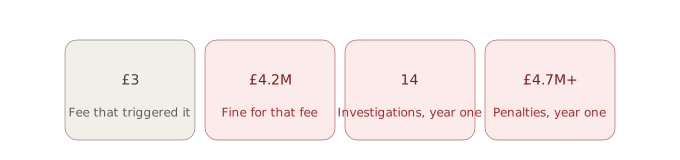
The regime is active and the first fine has landed. In April 2026 the CMA fined the AA's driving schools £4.2 million over a mandatory £3 booking fee that appeared too late in the purchase journey, with more than £760,000 in refunds ordered on top. In its first year under the new powers, the CMA opened investigations into 14 businesses, issued 157 advisory and warning letters, and imposed more than £4.7 million in penalties, with holidays and travel prominent among the sectors reviewed. An open investigation into Ryanair covers ancillary charges such as seating, baggage, and booking fees. The CMA can fine up to 10 percent of global annual turnover, or £300,000 if that is higher, without going to court first. For a platform, the exposure multiplies with scale: one stale tax rate repeats across every search result and listing that renders it.
Liability for the pricing rule and liability for the tax are different questions
The CMA rule governs what the customer sees. It does not decide who owes the tourist tax to the municipality; that allocation depends on the jurisdiction and the booking model, and it deserves its own piece. A platform can carry full display liability under the CMA rules even in markets where the host carries the tax obligation itself. The practical consequence is the same either way: the platform needs the correct local rate before the price renders, whoever ultimately remits the money.
Removing the exposure at the source
The pricing errors the CMA rule punishes rarely come from arithmetic. They come from stale inputs: a municipal rate that changed after launch, a seasonal variation nobody tracked, an exemption applied wrongly. Tourist tax is set locally, rates update without warning, and monitoring every jurisdiction is a full-time job. Trippz monitors every relevant jurisdiction and pushes updates automatically, and the Location Tax API returns the applicable rate for any location, with every calculation based on verified, up-to-date local rules. Trippz covers 70+ countries, is SOC1 Type 2 and SOC2 Type 2 certified and GDPR compliant, and counts Airbnb, Booking.com, and Expedia among its clients.
Trippz keeps the rate behind every displayed price current. Create your account to get sandbox access within two business days.