
 Deutsch
 Français
 Italiano
 Nederlands
 Spanish
Tourist tax and guest registration in Norway A complete guide
This guide tracks the tourist tax status and guest registration rules in Norway, from Oslo and Bergen to the fjords and the Polar Circle, updated as soon as anything changes.

Tourist tax in Norway
Norway has a national tourist tax law. Each municipality decides for itself whether to introduce it, and only municipalities under heavy tourism pressure are allowed to. Tromsø has decided to and is aiming at 2027. Bodø has a proposal in consultation. The Lofoten municipalities are preparing the same. Bergen says it wants one. Oslo has decided against it for now. Longyearbyen follows a separate system of its own. Other municipalities are considering it, and none of those has taken a decision yet.

Is there a tourist tax in Norway?
Norway has a national law that lets municipalities charge a tourist tax, and the first collection is expected on 1 January 2027. The Storting adopted the besøksbidrag law in June 2025, the ministry adopted the forskrift om overnattingsavgift on 22 May 2026, and both entered into force on 1 July 2026. The rate is fixed nationally at 3% of the accommodation price excluding VAT.
The condition that a municipality must document a particularly heavy burden from tourism was added by the Storting and left undefined in the forskrift, so the group of eligible municipalities is still taking shape.

How a municipality introduces the levy
A municipality adopts a plan for how the income will be spent and submits it to the Ministry of Trade, Fisheries and Food. The plan has to describe the local tourism sector and the pressure created by visitor numbers, consider cooperation with neighbouring municipalities, and show that affected businesses were consulted. Two or more municipalities can submit a joint plan.
Only after the ministry approves the plan can the council adopt a local forskrift, which sets the start date and whether the levy runs all year or only in certain months. That forskrift normally has to be published by 31 December of the preceding year, though for 2027 that deadline does not apply. The ministry's decision cannot be appealed. Income is restricted to tourism related public goods such as trail maintenance, public toilets, waste handling and visitor information, and cannot be used to balance the municipal budget.
Because each municipality decides on its own, the list of participating cities will grow as more councils complete their plans. No municipality can charge anything before its plan is approved and its local forskrift is published, so every introduction is known in advance. We follow each decision and update these guides as soon as a status changes.

Which stays are covered
The levy applies to paid overnight stays in hotels, hotel ships, hostels and other accommodation businesses, including private letting and short term rentals booked through platforms, where the stay lasts under 30 consecutive days. Stays in guests' own caravans, motorhomes and tents are outside it, as are seasonal pitches at campsites, while camping cabins are taxable. Further exemptions cover project related worker barracks, school trips, temporary housing under the Social Services Act, sports and cultural events in schools and halls, guest rooms in housing associations, member only accommodation run by unions and artist associations, company cabins, unstaffed facilities run by registered volunteer organisations, and military quarters.
The charge applies when the stay takes place rather than when it is booked, so a booking made before a municipality's start date is taxable for the nights falling after it.

Who is liable
The party offering the accommodation for payment charges the levy and pays it to the municipality. One exception matters in short term rental. If that party is not registered in the Norwegian VAT register and uses a third party to both market the stay and collect the payment, the intermediary is responsible for charging and remitting instead. An intermediary is not held liable for underpayment caused by incorrect information from the provider, and where several intermediaries sell one stay, the forskrift determines which one carries the obligation.

Cruise passengers are handled separately
A separate national regulation will let municipalities charge cruise passengers. The proposal is 100 NOK per passenger per commenced 24 hour period in port. The consultation closed on 22 June 2026. The regulation is expected to take effect in 2027 and collection could start in the first half of that year. Scheduled passenger ferries between Norway and foreign ports are exempt. As with the accommodation levy, only municipalities under heavy tourism pressure may introduce it.
Longyearbyen on Spitsbergen falls under a separate system. It would use a fixed amount per night instead of a percentage. That proposal is still being processed, so no amount is settled. See the Longyearbyen guide for the current status.

For hosts
Guest registration in Norway
When you are a host - or accommodation provider – in Norway, accommodation providers are required to collect and maintain specific information about all their guests, Norwegian and foreign nationals, to comply with national regulations. This practice ensures both safety and adherence to legal obligations.

Guest registration requirements in Norway
In Norway, operators of a hotel, guesthouse, lodging house, campsite and the like need to keep a register of all those who stay overnight, according to Utlendingsforskriften (Immigration Regulations), Section 20. There are mandatory guest registration requirements for accommodation providers, including hotels, holiday home owners, and campgrounds. These requirements are based on this law and apply to guests from outside the Norway but also for Norwegians themselves.
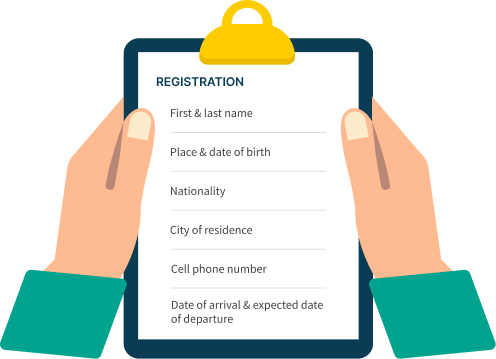
According to this law the guest shall personally complete and sign a declaration form stating the information below. Accommodation providers need to make sure to register the following data of the guests:
- Full name
- Date of birth
- Nationality
- Full residential address
- Date of arrival and departure
- Type and number of the travel document
Accommodation providers are required to verify their guests' identity using a valid identification document, such as a passport or national ID card.
Guest registration of children in Norway
If the guest is travelling with children under the age of 18, the children's names and dates of birth need to be noted on the form.
Guest registration for travelling in a group
For participants in a group travel group there is no need for the accommodation provider to have guests sign the declaration or to verify each guest's identity with a travel document or national ID card. All other registration requirements do apply though.
Storing of guest registration in Norway
There is no specific period that accommodation providers need to store guests' registration forms specified legally in Norway. However, it's worth noting that in other European countries, retention periods for such data typically range from a few months to several years. Also keep in mind that Norwegian Police can demand specific information about foreign guests of accommodation providers.
Frequently asked questions from hosts
-
Do I need to register my guests in Norway?
Yes, as a host or accommodation provider in Norway, Norwegian law requires this, Also the Police can demand accommodation providers for a list of all foreign overnight guests with the exception of Nordic citizens. This applies to all types of accommodations, from hotels to short-term rentals.
-
What guest details am I required to collect?
You need to record specific guest details, including:
- Guest's last name and first name
- Date of birth
- Position
- Nationality
- Residence
- Arrival and departure dates
- Type and number of the identity document presented
- Guest’s signature and the date of signing
Accommodation providers are required to verify their guests' identity using a valid identification document, such as a passport or national ID card. -
How long do I need to keep guest registration records?
There is no specific period that accommodation providers need to store guests' registration forms specified legally in Norway. However, Norwegian Police can demand specific information about foreign guests of accommodation providers. In other European countries, retention periods for such data typically range from a few months to several years.
-
Do I need to report guest details to authorities?
No, this is not required. However, if requested by the Norwegian Police, accommodation providers need to provide the police with a list of all foreign overnight guests with the exception of Nordic citizens.
-
Do I need to charge my guests a tourist tax in Norway?
No. Unlike many European countries, Norway does not currently have a tourist tax. However, regulations can change, and we’re keeping a close eye on any developments.
Trippz: the authority on tourist tax
Tourist tax is set locally and rates change without warning. Trippz tracks every change and keeps the data current, which is why travel platforms and property software, including Airbnb, Booking.com and Expedia, rely on Trippz to calculate tourist tax and register guests in every market they serve.

How Trippz stays current
Trippz checks tax rules jurisdiction by jurisdiction against official municipal and national sources. When a rate or rule changes, the update happens automatically rather than on a periodic review cycle. This is the same monitoring that travel platforms and software vendors depend on to stay accurate everywhere they operate.

One tax engine, every market
Send a location, get the applicable rate, instantly and correctly calculated. Travel platforms and property software embed this calculation directly into their own product, so every booking is taxed correctly without building or maintaining a rate engine in house. It is the same logic behind every rate on this page.

Frequently asked questions about Trippz
-
How can platforms and software vendors use Trippz?
Trippz provides tourist tax content and a ready made calculation engine through one API. Platforms and software vendors add accurate tax calculation to their product without maintaining a rate database in house. Guest registration and authority connections are available as a separate capability for those who need it.
-
How does Trippz keep tourist tax rates current?
Trippz checks the jurisdictions it covers against official sources and updates rates automatically when a city or country changes them.
-
Which countries and cities does Trippz cover?
Trippz maintains tourist tax data across a wide range of countries and cities. See the full overview in our tourist tax guides.
-
Is Trippz's data and infrastructure secure?
Yes. Trippz is SOC1 Type 2 and SOC2 Type 2 certified and GDPR compliant, so platforms and software vendors can embed tourist tax calculation without adding security or compliance risk of their own.
-
Who uses Trippz for tourist tax?
Trippz provides tourist tax data and calculation to travel platforms and property software across Europe, including Airbnb, Booking.com and Expedia. The same infrastructure that powers stays booked through the biggest platforms in travel is available to any platform or software vendor through the API.
municipality