
 Deutsch
 Français
 Italiano
 Nederlands
 Spanish
Tourist tax in San Marino A complete guide
San Marino’s medieval charm and Adriatic views draw travelers year-round. This guide explains the tourist tax, who pays it, what hosts must do, and how to stay compliant with ease.

Is there a tourist tax in San Marino?
Yes, San Marino has a tourist tax. The tax is not included in room rates and must be paid directly to the hotel and managed under Delegated Decree 30 May 2022 n.83, which sets out the rules for its collection and administration.
For tourists
Why is there a tourist tax in San Marino?
San Marino imposes a tourist tax to support its tourism-driven economy, as outlined in official guidelines. Governed by Delegated Decree 30 May 2022 n.83, the tax funds infrastructure and services for millions of annual visitors, ensuring the preservation of cultural heritage and sustainable tourism management.

Rate of the tourist tax in San Marino
The tourist tax in San Marino applies to visitors aged 14 and older staying in paid accommodations like hotels and campsites. Rates vary by their star rating, and are charged per person per night, with a maximum of 7 nights per establishment, as per official regulations.
| Accomodation type | Star rating | Tax rate |
|---|---|---|
| Hotel/Motel/RTA | 5 stars | €4.00 |
| Hotel/Motel/Tourist Village/RTA | 4 stars | €3.00 |
| Hotel/Motel/Tourist Village/RTA | 3 stars | €2.00 |
| Hotel/Motel/Tourist Village/RTA | 2 stars | €1.00 |
| Campsite | 4 stars | €0.80 |
| Campsite | 3 stars | €0.60 |
| Campsite | 2 stars | €0.40 |
| Campsite | 1 star | €0.20 |
| Bed & Breakfast/Guesthouse/CAV/ Religious Home/Rural Tourism/Youth Hostel | 1 star | €0.70 |
*No tax for guests under 14, regardless of accommodation type or stay duration.
**No tax applies after 7 nights
Frequently asked questions from tourists
-
Do I have to pay a tourist tax when staying in San Marino?
Yes, all visitors aged 14 and older staying in paid accommodations must pay a tourist tax in San Marino. The amount varies based on the type of accommodation and is charged for up to 7 nights.
-
How much is the tourist tax in San Marino?
The tourist tax ranges from €0.20 to €4.00 per person, per night, depending on the accommodation's category. For example, a stay in a five-star hotel incurs a tax of €4.00 per night, while a stay in lower-tier accommodations like one-star campsites incurs a tax of €0.20 per night.
-
Do children have to pay the tourist tax in San Marino?
No, children under 14 years old are exempt from paying the tourist tax in San Marino. Only guests who are 14 or older must pay the tax.
-
Is the tourist tax included in the price of my accommodation?
This depends on the accommodation provider. Some may include the tourist tax in the overall price, while others might charge it separately upon arrival or during checkout. Be sure to check with your accommodation provider.
-
What is the tourist tax used for in San Marino?
The tourist tax in San Marino helps fund public services, enhance tourism infrastructure, and support cultural and historical preservation. The revenue is reinvested to ensure that San Marino remains a sustainable and attractive destination.
For hosts
Guest registration in San Marino
All tourist accommodations in San Marino are required to maintain a guest register. This is mandated by regulations such as Law 22/2006 (Framework Law on Tourism) and related decrees, ensuring guest data is recorded and reported to authorities like the Gendarmerie Corps via the “Web Alloggiati” system.
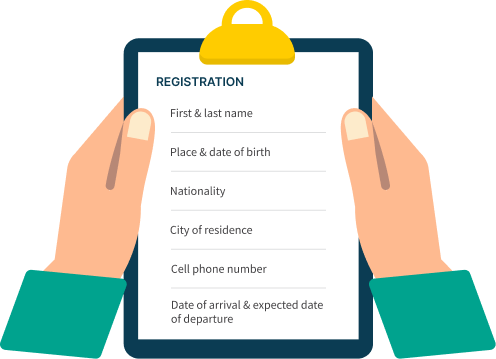
Guest registration details in San Marino
In the guest register, the following details must be recorded for each guest aged 14 or older:
- Full name
- Date and place of birth
- Nationality
- Gender
- Type and number of identity document (passport or ID card)
- Issuing country or authority
- Country or city of residence
- Dates of arrival and departure
Guests must present a valid identity document at check-in. The information must be entered into the Web Alloggiati portal within 24 hours.
Submission of the guest registration to the police in San Marino through Allogiati Web
Similar to the guest registration rules in Italy, the guest registration information must be securely transmitted to the San Marino authorities via the Web Alloggiati portal, the official digital system controlled by the Gendarmerie Corps. The information must be shared through the portal within 24 hours after check-in. Failure to comply with this 24-hour reporting requirement can result in administrative fines ranging from €154 to €1,032, depending on the severity of the violation.
Storing of guest registration in San Marino
In San Marino, guest registration data must be retained in accordance with Law no. 171 of 21 December 2018 (Data Protection Law), which specifies a general retention period of two years unless extended for archival, judicial, or public interest purposes.
Handling of tourist tax
-
Remittance of tourist tax
Hosts in San Marino are required to collect and remit the tourist tax (€1.5 per person per night, up to a maximum of 5 nights) to the State Tax Office. Funds must be transferred monthly, with detailed records of each guest’s stay and tax collected. Providers must ensure accurate reporting and timely payments to avoid penalties, as outlined in San Marino’s tourism and fiscal regulation.
-
Storing your administration for tourist tax
In San Marino, hosts are required to maintain detailed records of tourist tax collections, including guest information, amounts collected, remittance dates, and payment confirmations to the State Tax Office. These records must adhere to San Marino Law no. 171 of 21 December 2018 (Data Protection Law), ensuring secure storage and processing of personal data. Additionally, providers must retain all documentation for five years following the tax period to which they relate, as mandated by fiscal regulations for audit or inspection purposes.
-
Tourist tax when renting through an online booking platform
When renting through platforms like Airbnb or Booking.com, In San Marino, hosts renting through online platforms like Airbnb or Booking.com remain solely responsible for collecting and remitting the tourist tax.
Don’t want to worry about remitting the correct amount of tourist tax? That’s possible, with the use of Trippz!
-
Short-term rental registration requirements
In San Marino, short-term rental operators must register their properties under Law 22/2006 (Framework Law on Tourism) and obtain a license from the Economic Activities Office after an inspection by the Commission for the Classification and Supervision of Hospitality Businesses. Properties must display their license number in all promotional materials, including online listings, and use the “Web Alloggiati” system managed by the Gendarmerie Corps to register guest details (names, stay dates, and passport information). This applies to accommodations like hotel residences, guesthouses, and tourist apartments, with specific requirements for safety standards, room capacity, and service offerings.
Compliance involves periodic inspections to maintain license validity, adherence to data protection laws for guest records, and penalties for non-registration, including fines or operational suspension. Rural tourism properties fall under Law 23/2006 and require separate registration with the Environmental and Agricultural Resources Office. For legal reference, Law 22/2006 outlines licensing procedures, operational rules, and enforcement mechanisms.

Frequently asked questions from hosts
-
Do I need to register my short-term rental property in San Marino?
Yes. Short-term rentals must be registered under Law 22/2006 (Tourism Framework Law) and licensed by the Economic Activities Office. Properties must display the license number in all promotional materials.
-
What information do I need to collect from guests staying in my accommodation?
You must collect full name, passport number, nationality, and stay dates. This data must be submitted via the “Web Alloggiati” system to the Gendarmerie Corps within 24 hours of arrival.
-
Are there differences for San Marino guests vs. foreign guests?
No. All guests, regardless of nationality, must be registered through the same process. Foreigners staying over 30 days require a separate permit from the Gendarmerie.
-
How long do I need to store the guest registration records?
Guest data must be securely stored for the duration required by local data protection laws.The records are to be reatined for 5 years under Law no. 171/2018 (data protection). Extended retention applies only for judicial or archival purposes.
-
What are the penalties if I don’t register my short-term rental property?
Failure to register or submit guest data may result in fines (up to €10 million for severe violations) and operational suspension.
How Trippz helps hosts
Renting out your accommodation comes with real administrative work: registering guests, calculating the right tourist tax, and collecting it from every booking. Trippz automates all of it. It is the only company in the space that calculates and collects tourist tax for you, and keeps every rate up to date.

Tourist tax calculated, collected and kept current
Tourist tax rules are set locally and change without warning. Trippz monitors rates in 70+ countries and applies the correct amount to every stay, so you never have to track a rate change yourself. Your guests receive a payment request on arrival day and pay their tourist tax digitally. Trippz pays the collected amount out to you monthly, with a clear overview. You simply forward the total to your municipality.

Guest registration via Alloggiati Web and Istat
Manually submitting guest data to Italian authorities takes time and increases the risk of mistakes. Trippz offers direct integrations with Alloggiati Web and Istat, so guest registration and monthly statistics are handled automatically, in the correct format and always on time.
As soon as a guest checks in, their data is sent securely to Alloggiati Web. Trippz also manages the monthly Istat reporting. You do not need to log in to external portals or upload files manually. The data is always accessible in your dashboard, and you can review or edit it before it is submitted. Bookings sync automatically through property management systems like Lodgify, Guesty and Smoobu. See all current connections on our integrations page.

ID verification for compliant self check-in
Italian law requires hosts to visually verify that the person checking in matches the identity document provided. A keybox alone does not meet that requirement. With Trippz ID verification, your guest submits their identity document and completes a live verification before arrival, then confirms their identity at check-in with a live selfie and their location or a QR code at the property. You meet the verification requirement without being on-site, and your guests keep the convenience of self check-in.

Frequently asked questions about Trippz
-
How can platforms and software vendors use Trippz?
Trippz provides tourist tax content and a ready made calculation engine through one API. Platforms and software vendors add accurate tax calculation to their product without maintaining a rate database in house. Guest registration and authority connections are available as a separate capability for those who need it.
-
How does Trippz keep tourist tax rates current?
Trippz checks the jurisdictions it covers against official sources and updates rates automatically when a city or country changes them.
-
Which countries and cities does Trippz cover?
Trippz maintains tourist tax data across a wide range of countries and cities. See the full overview in our tourist tax guides.
-
Is Trippz's data and infrastructure secure?
Yes. Trippz is SOC1 Type 2 and SOC2 Type 2 certified and GDPR compliant, so platforms and software vendors can embed tourist tax calculation without adding security or compliance risk of their own.
-
Who uses Trippz for tourist tax?
Trippz provides tourist tax data and calculation to travel platforms and property software across Europe, including Airbnb, Booking.com and Expedia. The same infrastructure that powers stays booked through the biggest platforms in travel is available to any platform or software vendor through the API.
municipality