
 Deutsch
 Français
 Italiano
 Nederlands
 Spanish
Tourist tax in Australia A complete guide
Welcome to your comprehensive guide on navigating tourist tax in Australia. Whether you’re a tourist or a host, we’ve got all the essentials covered with clarity to keep things simple.

Is there a tourist tax in Australia?
In Australia, there is no nationwide tourist tax, but there are tourist taxes per state. It’s important to know that Australia does not have a tourist tax except in Victoria, and the Australian Capital Territory. Thes state simposes a specific levy on short-term stays, while the rest of the country, think New South Wales, Queensland, or Tasmania, does not charge any tourist tax. In Victoria, this tax is known as the Short Stay Levy (SSL). In the Australian Capital Territory, it's called the Short-term rental accommodation levy (STRAL).
For tourists
Why is there a tourist tax Australia?
The tourist tax supports local infrastructure and services that enhance your travel experience. Funds go towards maintaining tourism hotspots, improving facilities, and ensuring sustainable visitor experiences. It’s a small contribution to keep (parts of) Australia welcoming for millions each year.
What is the rate of the tourist tax in Victoria, Australia?
In Australia, you are considered subject to the tourist tax if you stay overnight for a fee in an accommodation facility in Victoria, regardless of your place of residence. This tax, known as the Short Stay Levy (SSL), is applied to the total cost of the stay for overnight services at facilities such as hotels, motels, and short-term rental properties, rather than a fixed per-night or per-person rate. Remember, this levy is specific to Victoria as other states and territories do not impose a tourist tax.
| Length of Stay (Continuous Nights) | Tourist tax rate |
|---|---|
| Less than 28 | 7.5% |
| 28 or more | 0% |
Is tourist tax being considered in Queensland?
Yes, there is discussion about introducing a tourism tax in Queensland. According to recent reports, Queensland's Tourism Minister has indicated a willingness to consider a visitor tax as part of a new 20-year tourism strategy for the state. This proposal is being discussed as a potential measure to fund local infrastructure used by tourists, often referred to as a 'bed tax' in similar contexts.
What is the rate of the tourist tax in Australian Capital Territory?
In the Australian Capital Territory, a levy applies to short-term rental accommodation bookings of fewer than 28 consecutive days, where the booking is made through an online booking service. Known as the Short-Term Rental Accommodation (STRA) Levy, it is calculated as a percentage of the total consideration paid, which includes the accommodation charge, applicable taxes, and associated fees such as cleaning or booking fees. Booking service providers are responsible for paying the levy.
| Length of Stay (Continuous Nights) | Tourist tax rate |
|---|---|
| Less than 28 | 5% |
| 28 or more | 0% |
Frequently asked questions from tourists
-
Do I have to pay a tourist tax when staying in Australia ?
Only if you’re staying in Victoria for 28 days or less in paid accommodation. The rest of Australia does not have a tourist tax.
-
How much is the tourist tax in Victoria (Australia)?
The SSL in Victoria is 7.5% of the total booking fee, including additional charges like cleaning fees.
-
Do children have to pay the tourist tax in Victoria (Australia)?
Yes, the tourist tax in Victoria, known as the Short Stay Levy (SSL), applies to all guests staying in paid accommodation for less than 28 days, regardless of age. There are no specific exemptions mentioned for children in the current regulations.
-
Is the tourist tax included in the price of my accommodation?
This depends on the provider or platform. Some may include the SSL( in Victoria) in the booking price, while others might list it separately at checkout. Always check with your accommodation host for clarity.
-
What is the tourist tax used for in Victoria (Australia)?
The SSL funds tourism infrastructure, public services, and sustainability efforts, ensuring Victoria remains a top destination for travelers.
For hosts
Guest registration in Australia
Guest registration in Australia isn’t governed by a single national law but varies by state, territory, and local council. For short-term rental hosts, particularly in areas like Victoria where the SSL applies, collecting guest information is often necessary for tax compliance and safety regulations. While there’s no universal mandate akin to a national address registration system, certain jurisdictions or booking platforms may require hosts to record specific details to ensure transparency and accountability.
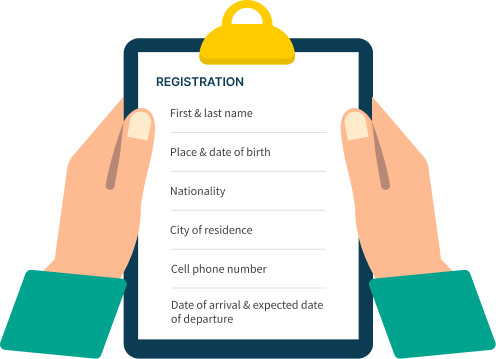
Guest registration details in Australia
When registration or data collection is required, typically for stays of 28 days or less, the following details are commonly collected for all guests, whether Australian or international:
- Full name
- Contact information (such as phone number or email)
- Dates of arrival and departure
In some cases, local regulations or platforms like Airbnb may request additional identification details for security purposes. Always check with your local council or booking platform to confirm what’s needed in your area.
Submission of the guest registration to the police in Australia
Unlike some countries with centralized police reporting systems, like Italy, or Spain, Australia does not generally require hosts to submit guest details to law enforcement unless specific local laws or safety regulations apply. Instead, guest information is often collected for tax compliance (like the SSL in Victoria) or platform policies. If submission is required, it’s typically handled through the booking platform or reported to local authorities as per state or council guidelines. Timelines and methods for submission can vary, so it’s best to stay updated on your local requirements to avoid any penalties.
Storing of guest registration in Australia
Data retention periods for guest information aren’t universally defined across Australia but should align with the Privacy Act 1988, which governs how personal information is handled. As a best practice, hosts are encouraged to securely store guest records for up to 5 years to cover potential audits or compliance checks related to tourist tax or safety regulations. Storage must comply with Australian data protection laws to ensure guest privacy is protected - think secure digital files or encrypted systems to keep everything safe and sound.
Handling of tourist tax
-
Remittance of tourist tax
In Victoria, accommodation providers and online booking platforms (like Airbnb or Booking.com) are responsible for collecting the SSL from guests. They must remit this levy to the state government, typically on a periodic basis. Providers are required to maintain accurate records and ensure timely payments to avoid penalties.
-
Storing your administration for tourist tax
Hosts and platforms must keep detailed records of SSL collections, including guest details, amounts collected, and remittance dates. While specific retention periods may vary, compliance with Australian data protection regulations is essential for secure storage and future audits by tax authorities.
-
Tourist tax when renting through an online booking platform
When booking through platforms like Airbnb or Booking.com, the SSL is often collected automatically for stays in Victoria. It’s the provider’s duty to ensure compliance and remit the tax to the government. As a guest, confirm whether the tax is included in your quoted price or added separately.
Don’t want to worry about remitting the correct amount of tourist tax? That’s possible, with the use of Trippz!
-
Automate tourist tax collection with Trippz
Trippz knows the correct tourist tax rate for every region. Whether it depends on accommodation type, season, or guest age, the right rate is always applied. This removes guesswork and ensures full compliance from the start.
At check-in, the tourist tax is collected automatically through our app. You no longer need to calculate amounts manually or explain the fee to your guests. Trippz gives you a clear overview for every booking, so you always know what has been charged and what still needs to be remitted. You save time, avoid errors, and stay in control. Even when managing multiple properties.

-
Short-term rental registration requirements
In Australia, short-term rental regulations vary by state and local council. In Victoria, where the SSL applies, hosts offering accommodations for stays of 28 days or less are often required to register with local authorities or comply with specific state guidelines. Registration ensures compliance with tax obligations and safety standards. Non-compliance can lead to fines or restrictions on operating your rental, so it’s crucial to check local requirements or platform policies to stay on the right side of the rules.
-
SSL and GST in Australia
The SSL (Short Stay Levy) is the tourist tax specific to Victoria, applied to short-term accommodation bookings. On the other hand, the GST (Goods & Services Tax) is a federal sales tax of 10% that applies to most goods and services across Australia, including accommodation. While SSL is a local charge in Victoria, GST is a nationwide standard.

Frequently asked questions from hosts
-
Do I need to register my short-term rental property in Australia ?
Yes, but only if your property is in Victoria and the booking is for 28 days or less. You’re required to collect the SSL and remit it to the state government.
-
What information do I need to collect from guests staying in my accommodation?
For compliance, especially in Victoria where the Short Stay Levy (SSL) applies, you should collect each guest’s full name, contact details, and dates of stay. While not always mandatory across Australia, some local councils or booking platforms may require additional identification details for safety and tax purposes. Always confirm with your booking platform or local regulations to ensure you’re meeting the necessary standards.
-
Are there any differences in the registration process for Australian and foreign guests?
No, there are generally no differences in the registration process for Australian and foreign guests when it comes to short-term accommodation in Australia. Whether guest data collection is required by local laws, booking platforms, or for tax compliance (like the Short Stay Levy in Victoria), the process is typically the same for all guests, regardless of nationality. Always check specific state or local council regulations or platform policies to confirm if additional identification is needed, but nationality does not usually alter the procedure.
-
How long do I need to store the guest registration records?
There is no universally mandated retention period for guest registration records in Australia for short-term rental hosts. However, for general business and tax compliance under Australian laws like the Privacy Act 1988, it’s best practice to securely store records for up to 5 years to cover potential audits or disputes.
-
What are the penalties if I don’t register my Short-Term Rental property?
Penalties for not registering a short-term rental property vary by state and local council. In South Australia, failing to register can result in fines up to $5,000 with an expiation fee of $315 . In Noosa, Queensland, fines for non-compliance are over $800 per infringement . In New South Wales, non-compliance with the Code of Conduct can lead to strikes or exclusion from renting for up to 5 years . Always check specific local rules to avoid penalties or operational restrictions.
Trippz: the authority on tourist tax
Tourist tax is set locally and rates change without warning. Trippz tracks every change and keeps the data current, which is why travel platforms and property software, including Airbnb, Booking.com and Expedia, rely on Trippz to calculate tourist tax and register guests in every market they serve.
How Trippz stays current
Trippz checks tax rules jurisdiction by jurisdiction against official municipal and national sources. When a rate or rule changes, the update happens automatically rather than on a periodic review cycle. This is the same monitoring that travel platforms and software vendors depend on to stay accurate everywhere they operate.

One tax engine, every market
Send a location, get the applicable rate, instantly and correctly calculated. Travel platforms and property software embed this calculation directly into their own product, so every booking is taxed correctly without building or maintaining a rate engine in house. It is the same logic behind every rate on this page.

Frequently asked questions about Trippz
-
How can platforms and software vendors use Trippz?
Trippz provides tourist tax content and a ready made calculation engine through one API. Platforms and software vendors add accurate tax calculation to their product without maintaining a rate database in house. Guest registration and authority connections are available as a separate capability for those who need it.
-
How does Trippz keep tourist tax rates current?
Trippz checks the jurisdictions it covers against official sources and updates rates automatically when a city or country changes them.
-
Which countries and cities does Trippz cover?
Trippz maintains tourist tax data across a wide range of countries and cities. See the full overview in our tourist tax guides.
-
Is Trippz's data and infrastructure secure?
Yes. Trippz is SOC1 Type 2 and SOC2 Type 2 certified and GDPR compliant, so platforms and software vendors can embed tourist tax calculation without adding security or compliance risk of their own.
-
Who uses Trippz for tourist tax?
Trippz provides tourist tax data and calculation to travel platforms and property software across Europe, including Airbnb, Booking.com and Expedia. The same infrastructure that powers stays booked through the biggest platforms in travel is available to any platform or software vendor through the API.
municipality