
 Deutsch
 Français
 Italiano
 Nederlands
 Spanish
Tourist tax in Switzerland A complete guide
Famous for its breathtaking Alps, pristine nature, and cosmopolitan cities, Switzerland offers travelers a unique experience. In our tax guide, we provide everything you need to know about Switzerland’s tourist tax—what the rates are, who pays it, how compliance works, and how to manage it effortlessly.

Why do municipalities in Switzerland levy tourist taxes?
Municipalities in Switzerland levy tourist taxes to finance tourism infrastructure and services, promote and market the region, protect and care for the environment, ensure waste disposal and cleaning, support cultural and sporting events and ensure a high quality of service. In this way, tourism is promoted sustainably, and the costs are not passed on to the local population alone.
Tourist tax by municipality in Switzerland
Want to know the rules regarding tourist tax per municipality in Switzerland? Trippz collects all data about tourist tax. Below is an overview of the specific tourist tax rules of various municipalities in Switzerland?

Is the municipality you are looking for not listed? Let us know, and we'll send you more information.
For tourists
When is a tourist tax in Switzerland payable?
In Switzerland, you have to pay a tourist tax if you stay overnight in a tourist area. The visitor's tax, also known as the Kurtaxe, is levied per overnight stay and per person. It is usually collected by hotels, holiday flats, campsites and other accommodation provider. The amount of the tourist tax varies depending on the municipality and can be between 1 and 7 Swiss francs per night.

Who is exempt from the tourist tax?
In Switzerland, there are certain groups of people who are exempt from the tourist tax. These exemptions may vary depending on the canton or municipality, but the following exemptions generally apply:
Children and young people: In many communes, children under a certain age (often under 12 or 16) do not have to pay tourist tax.
Business travellers: People staying in a region for business reasons may be exempt from the tourist tax if they can provide proof of this.
Longer-term stays: People staying in a municipality for longer periods (often longer than 30 days), for example for professional purposes or as students, may also be exempt from the tourist tax.
Residents and owners of second homes: People who have their main residence in the municipality in question, as well as owners of second homes who use the property themselves, often do not pay the tourist tax.
People with special circumstances: Sometimes there are specific regulations for people in special situations, such as patients in hospitals or rehabilitation centres.
The exact exemptions may vary from municipality to municipality, so it is advisable to check directly with the local tourism authority or municipal administration for specific information.
The structure of tourist taxes in Switzerland
In Switzerland, the tourist tax is organised at cantonal and local level, resulting in a diverse and flexible structure. The amount of the tourist tax is determined individually by the municipalities and/or canton. It varies between CHF 0 and CHF 7 per adult per night. Here are the main aspects:
Tourist tax on the provincial (cantonal) level
The cantons set the legal framework for levying the tourist tax. They determine the principles and can either set a fixed amount or minimum and maximum amounts. In the latter case, the individual municipalities are responsible for setting a fixed amount, which means that each municipality levies a different amount. In some cantons, there are efforts to harmonise the tourist tax within the canton in order to create a uniform regulation.
Tourist tax on the local level (communes)
The municipalities set the specific rates of the tourist tax, which can vary depending on the region, tourist importance and type of accommodation. These rates are typically between 1 and 7 Swiss francs per night.
additional fees:
In some cantons and municipalities, there is an additional fee, such as a tourism promotion contribution or tourism tax.
What are the benefits of a tourist tax for tourists?
Tourist services: The revenue from the tourist tax is used to fund tourist services, including information centres, promotional materials and tourist infrastructure such as hiking trails and ski slopes.
Events and culture: Funds are also used to organise events and cultural activities that attract tourists.
Public transport: In many tourist regions, public transport for tourists is subsidised or offered free of charge.
Development of tourist taxes in Switzerland
The level of tourist tax in Switzerland tended to rise in recent years. The reasons for this are adjustments to inflation, seasonal rates, different rates depending on the type of accommodation and regional differences. Some municipalities have introduced flat rates and efforts are being made to make the use of revenue more transparent.
Frequently asked questions from tourists
-
Am I, as a guest, responsible for properly remitting the tourist tax?
In Switzerland, the responsibility for remitting the tourist tax typically falls on the accommodation provider, not the guest. Hotels, guesthouses, and other types of accommodations usually include the tourist tax in the overall bill you pay. The accommodation provider then forwards this tax to the local authorities. However, if you are staying in a private rental (e.g., Airbnb or similar), the process can vary. In some cases, the platform or the host may charge the tourist tax separately, while in others, the guest might need to pay it directly to the local authorities, although this is less common. As a guest, it's important to verify whether the tourist tax is included in your booking fee or if you need to settle it separately. Checking with your host or accommodation provider in advance can help clarify this.
-
At what point do I have to pay the tourist tax?
The tourist tax in Switzerland is generally paid at the same time as your accommodation bill. This could be:
At Check-Out: In many hotels, guesthouses, and traditional accommodations, the tourist tax is included in the final bill you receive when checking out. You pay it along with your room charges.
At the Time of Booking: Some online booking platforms (like Airbnb or Booking.com) include the tourist tax in the total price when you make the reservation. In this case, you would pay the tax upfront as part of the booking process.
Directly During Your Stay: In rare cases, especially in smaller or private accommodations, the host may request the tourist tax separately during your stay. This could happen if they collect it in cash or if it’s handled differently from the room rate.
Always check with your accommodation provider or review your booking details to understand when and how the tourist tax will be collected.
-
Do I have to pay the tourist tax in cash to the accommodation provider?
No, you generally do not have to pay the tourist tax in cash to the accommodation provider. In most cases, the tourist tax is included in your total accommodation bill and can be paid using the same payment method you use for the rest of the booking, whether that’s by credit card, debit card, or another electronic payment method.
However, in smaller establishments or private rentals, some hosts might prefer or request payment in cash, though this is less common. It’s always a good idea to confirm with your accommodation provider in advance if you’re unsure about the payment method for the tourist tax.
-
I need to register upon arrival at my hotel. Is this mandatory?
Yes, registering upon arrival at your hotel in Switzerland is mandatory. This is a legal requirement for all guests staying in hotels, guesthouses, and other accommodations. The registration process involves providing personal information, such as your name, passport or ID details, and possibly your home address. This information is used to fulfill local regulations, including those related to the tourist tax.
The hotel will usually ask you to fill out a registration form upon check-in. In some cases, this may be done electronically. The information you provide is also used to calculate the correct amount of tourist tax you need to pay, which is often based on the number of nights you stay.
Failure to register could lead to issues with your stay or with local authorities, so it’s important to complete this step as required.
-
May the hotel where I am staying make a copy of my passport for guest registration?
In Switzerland, it is common practice for hotels to ask for your passport upon check-in to verify your identity and complete the guest registration process;
Verification: Hotels are legally required to verify the identity of their guests, typically by checking a passport or other valid ID. This information is recorded for security and legal purposes.
Copying: While many hotels in Switzerland may take a photocopy of your passport as part of their standard procedure, this practice is not uniformly regulated by law across the country. The purpose of making a copy is usually to facilitate guest registration, especially if the information is required by local authorities.
Data Protection: Swiss data protection laws require that personal information, including copies of passports, be handled with care and only retained for as long as necessary. If you are concerned about your privacy, you can ask the hotel how they intend to store and use your passport information and whether they can return or destroy the copy after your stay.
-
I have cancelled my stay. Do I still have to pay tourist tax?
No, if you have canceled your stay and do not use the accommodation, you generally do not have to pay the tourist tax in Switzerland. The tourist tax is typically only charged for nights that you actually spend at the accommodation.
If you cancel your reservation according to the accommodation’s cancellation policy and do not stay at the property, the tourist tax should not apply. However, if there are cancellation fees or other charges, these would be separate from the tourist tax.
If you are unsure or if you were charged a tourist tax despite canceling, it's best to contact the accommodation provider directly to clarify the situation.
-
Upon arrival at the hotel, I am asked to pay tourist tax. But surely I have already done this through the booking platform?
If you have already paid the tourist tax through the booking platform, you should not be asked to pay it again upon arrival at the hotel. However, misunderstandings can occur, so it’s important to clarify this with the hotel staff. Here’s what you can do:
- Check your booking confirmation: Review your booking confirmation or receipt from the platform to see if the tourist tax is listed as part of the total amount you paid. It may be itemized separately or included in the overall price.
- Show proof of payment: If the tourist tax was included in your booking, show the confirmation or receipt to the hotel staff to avoid paying it twice. This should resolve the issue.
- Discuss with the hotel: If the hotel still insists on charging the tourist tax, ask them to verify whether it was already collected by the booking platform. Sometimes, the hotel might not have received notification of the tax payment from the platform.
In most cases, the issue can be resolved quickly by showing the proof of payment. If needed, you can also contact the booking platform's customer service for assistance.
For hosts
Renting out in Switzerland: there is a lot involved
Do you rent to tourists in Switzerland? If so, it is important to understand what is coming your way. You will probably have to classify your accommodation, keep a guest registration, and collect and remit tourist tax.
This can seem complex and overwhelming. Fortunately, we are here to help you get started!

Obligations of the landlord
If you are renting to tourists in Switzerland, there are a few important points to bear in mind regarding tourist tax:
Obligation to collect
Landlords are legally obliged to collect tourist tax from their guests and pass it on to the relevant municipality or canton.
Amount of tourist tax
The amount of the tourist tax varies depending on the region and type of accommodation. Ask the local tourism authority about the current rates.
Recording and billing
Landlords must record the tourist tax correctly and bill it regularly. This is usually done using a registration form that is submitted to the municipality.
Transparency for guests
Landlords should inform their guests about the tourist tax, either through a notice on the booking platform or directly on arrival. The tourist tax is usually charged in addition to the accommodation price.
Use of the tourist tax
The revenue from tourist taxes is used for the region's tourist infrastructure and services. This can inform guests and increase their acceptance of the fee.
Obligation to register
Many municipalities require landlords to register their guests and provide the relevant data (e.g. length of stay, number of persons). This information is important for calculating the tourist tax.
Tax aspects
Tourist taxes are not normally taxable as landlord income as they are paid directly to the municipality. Nevertheless, landlords should ensure that they fulfil the legal and tax requirements.
Controls and sanctions
Municipalities can carry out checks to ensure that tourist taxes are collected and paid correctly. Sanctions or fines may be imposed for non-compliance.
Guest registration in Switzerland
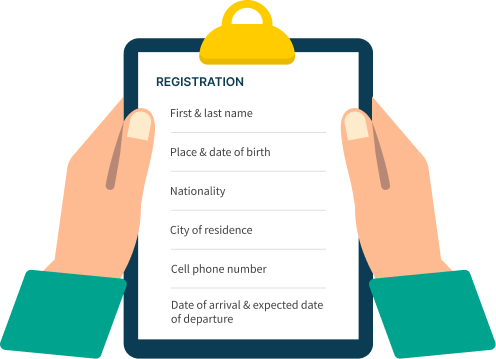
If you rent to tourists in Switzerland, you are legally obliged to record certain guest data and register them with the relevant municipality. This registration serves to fulfil the obligation to register and is important for the billing of the tourist tax. The data recorded usually includes the following data of the main guest:
- Full name
- Residential Address
- Date of birth
- Nationality
- ID Document number
Next to that, the following data is stored:
- Arrival- and departure date
- Number of persons traveling with the main guest, often broken down into adults and children.
How the data is recorded
This data must be recorded on a guest sheet or a digital registration form and forwarded to the local authority. The data is used for correct billing of the tourist tax, tourist statistics and compliance with the legal obligation to register.
Storing of guest registration in Switzerland
In Switzerland, guest registration data collected for the purpose of levying tourist tax must be retained for a certain period of time. This retention period can vary depending on the canton and municipality. As a rule, however, the following principles apply:
Minimum retention period
The data must usually be retained for at least 3 to 5 years. This enables the authorities to verify the correctness of the tourist tax collection in the event of an inspection or audit.
Legal basis
The exact deadlines and requirements for storage may be specified in the cantonal or communal regulations on tourist tax. It is therefore advisable to check the specific provisions of the respective municipality or canton.
Data protection
During the retention period, the data must be stored securely in accordance with the applicable data protection laws. This means that it should be protected from unauthorised access and properly destroyed after the retention period has expired.
Electronic and physical storage
Data can be stored in both electronic and paper form, as long as it is secure and accessible in the event of an inspection by the authorities.
To ensure that you comply with legal requirements, you should check with the relevant tourism authority or municipality for specific retention periods and conditions.
Don’t want to worry about keeping your guest registration?
That’s possible, with the use of Trippz!
Handling of tourist tax in Switzerland
-
Remittance of tourist tax
Although the exact rules of tourist tax vary by municipality in Switzerland, everywhere it is the accommodation provider who remits the tourist tax to the municipality/canton. In most municipalities this is done every (half) year, but municipalities may decide in which period the tourist tax should be remitted.
-
Tourist tax when renting through an online booking platform
Do you rent out your accommodation through a booking platform, such as Airbnb, Booking.com or Expedia? Then - in some cities - they will collect the tourist tax on your behalf and remit it to the municipality. If, in addition to a booking platform, you also rent out your accommodation under your own management (for example, through your own website), you will still have to collect and remit the tourist tax on these bookings yourself.
A good example of specific agreements with online booking platforms is the canton of Lucerne (page 15). The Luzerner Zeitung also wrote about it.
-
Collecting tourist tax
Tourist tax has many different rates. These depend on the municipality and province in which your accommodation is located and what kind of accommodation you provide. These factors are not very complicated, as they remain the same continuously. However, the rate also depends, for example, on the age of the guests, how long they stay, and in some cases in which period the guests stay with you.
Are guests leaving earlier than initially planned? Then they are entitled to a refund of the overpaid tourist tax.
-
Keeping your administration for tourist tax
As with guest registration, your records for tourist tax can be audited. So, you will need to keep good records of who stayed in your accommodation, on what date, for how many nights, and how much tourist tax was paid for this. It is recommended to keep these records for several years.
Don’t want to spend hours checking your administration?
Frequently asked questions from hosts
-
Can you receive fines if you don't pay tourist tax?
Yes, as an accommodation provider, you can receive fines or face other penalties if you fail to remit the tourist tax. Municipalities in Switzerland are strict about collecting and remitting this tax, and non-compliance can lead to fines, legal action, or even operational restrictions.
-
Am I required to request a rating for my accommodation?
No, you are not required to request a rating for your accommodation. While reviews and ratings can help improve your business's visibility and reputation, requesting them is entirely optional.
-
To whom should I pay the tourist tax?
You must remit the collected tourist tax to your local municipality or the province, according to the regulation. The process usually involves reporting the number of guests and nights stayed and paying the corresponding amount to the municipal authorities according to their procedures.
-
Should I enclose the guest registration as proof when remitting tourist tax?
It depends on your municipality. With most municipalities, you do not have to share detailed information, like the names of your guests. However, some municipalities require you to submit guest registration information as part of the tourist tax remittance process, as this information helps to verify the accuracy of the tax remitted.
The exact documentation required can vary, so check with your municipality.
-
Does my municipality have a special form for tourist tax remittance?
Most municipalities in Switzerland have specific forms or online systems for tourist tax remittance. These forms may include details about the number of guests, duration of stays, and the total tax collected. Contact your local municipality or visit their website to obtain the correct forms or access their online portal.
-
Do I declare per accommodation, or all together?
This depends on your municipality’s requirements. If you manage multiple properties, some municipalities might require separate declarations for each property, while others allow or require you to consolidate the information and declare it together. Always check with your local authorities to ensure compliance.
-
Do I also have to pay tourist tax on cancelled bookings?
No, you do not have to pay tourist tax on canceled bookings if the guest did not stay at your property. The tax is only payable for nights the guest stays. If the tax was collected in advance and the booking is canceled, you should adjust your records and, if necessary, refund the tax to the guest
-
How do I make this all as simple as possible?
To simplify the process, consider using specialized software or services that automate the collection, calculation, and remittance of tourist tax. Trippz is designed by and for hosts, so we can help streamline the administrative burden by integrating with booking platforms, automating guest registration, and handling tax payments on your behalf. Additionally, keeping detailed and organized records can help ensure accuracy and compliance with local regulations.
Trippz: the authority on tourist tax
Tourist tax is set locally and rates change without warning. Trippz tracks every change and keeps the data current, which is why travel platforms and property software, including Airbnb, Booking.com and Expedia, rely on Trippz to calculate tourist tax and register guests in every market they serve.
How Trippz stays current
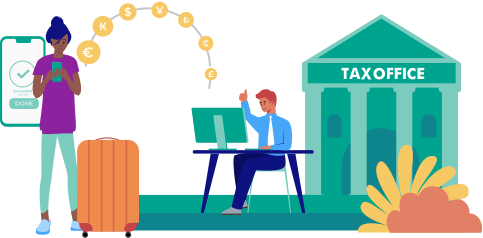
Trippz checks tax rules jurisdiction by jurisdiction against official municipal and national sources. When a rate or rule changes, the update happens automatically rather than on a periodic review cycle. This is the same monitoring that travel platforms and software vendors depend on to stay accurate everywhere they operate.

One tax engine, every market
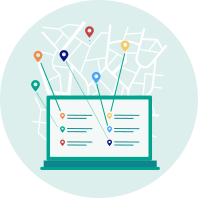
Send a location, get the applicable rate, instantly and correctly calculated. Travel platforms and property software embed this calculation directly into their own product, so every booking is taxed correctly without building or maintaining a rate engine in house. It is the same logic behind every rate on this page.
Frequently asked questions about the use of Trippz
-
How can platforms and software vendors use Trippz?
Trippz provides tourist tax content and a ready made calculation engine through one API. Platforms and software vendors add accurate tax calculation to their product without maintaining a rate database in house. Guest registration and authority connections are available as a separate capability for those who need it.
-
How does Trippz keep tourist tax rates current?
Trippz checks the jurisdictions it covers against official sources and updates rates automatically when a city or country changes them.
-
Which countries and cities does Trippz cover?
Trippz maintains tourist tax data across a wide range of countries and cities. See the full overview in our tourist tax guides.
-
Is Trippz's data and infrastructure secure?
Yes. Trippz is SOC1 Type 2 and SOC2 Type 2 certified and GDPR compliant, so platforms and software vendors can embed tourist tax calculation without adding security or compliance risk of their own.
-
Who uses Trippz for tourist tax?
Trippz provides tourist tax data and calculation to travel platforms and property software across Europe, including Airbnb, Booking.com and Expedia. The same infrastructure that powers stays booked through the biggest platforms in travel is available to any platform or software vendor through the API.
municipality